
"Agentic AI" is the phrase of the year in research technology. Every platform announcement, every conference keynote, every funding round seems to invoke it. The agentic AI market is projected at $50 billion by 2030. Greenbook named agentic workflows the #1 success factor for research firms in 2026.
But if you ask five people what "agentic AI" means, you'll get six answers.
Let's fix that — specifically for survey research.
Start with what it's not
An agentic AI is not a chatbot. Chatbots respond to prompts. You ask, they answer. The interaction is conversational and stateless — each exchange is largely independent.
An agentic AI is not a copilot. Copilots assist with a task you're already doing. They suggest the next line of code, auto-complete a sentence, or recommend an action. You're still driving. They're the passenger with opinions.
An agentic AI is not an automation script. Scripts follow predetermined paths. If X, then Y. They don't make decisions, resolve ambiguities, or adapt when the input is messy.
So what is it?
An agent is an AI system that can pursue a goal across multiple steps, making decisions along the way, without requiring human input at every step.
Three properties distinguish agents from simpler tools:
-
Goal-directed behavior. You give the agent an objective ("program this questionnaire into a deployable survey"), not a sequence of instructions. The agent figures out the steps.
-
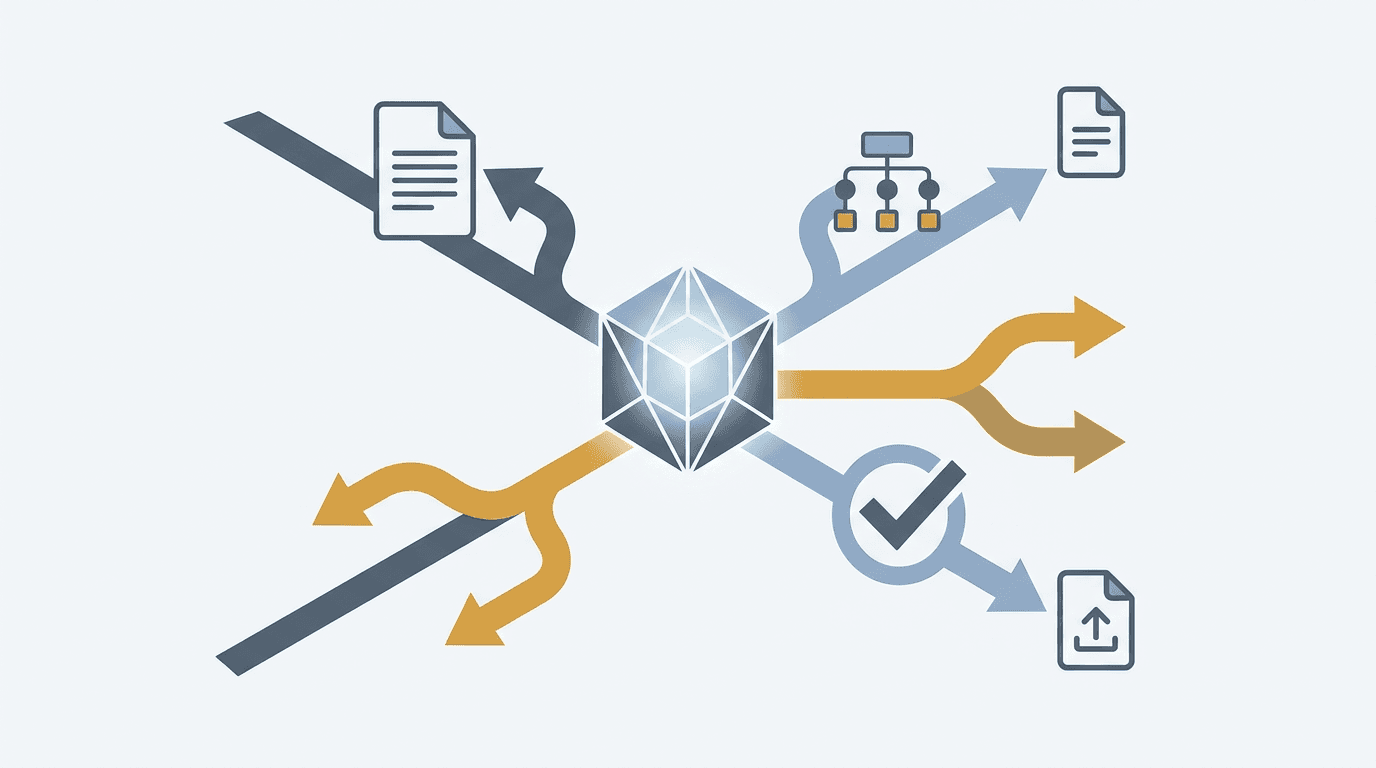
Multi-step reasoning. The agent doesn't produce output in one shot. It reads, plans, executes, validates, and revises — the same cognitive loop a human would follow, but compressed.
-
Decision-making under ambiguity. Real-world inputs are messy. A questionnaire spec might describe routing logic in prose, use inconsistent question numbering, or reference a question that doesn't exist yet. An agent resolves what it can and flags what it can't.
What this looks like in survey research
Take a concrete example. A researcher uploads a 40-page Word document — a brand tracking study with screening questions, quota controls, matrix grids, open-ends, skip logic, and piped text.
Here's what a non-agentic tool would do: ask the researcher to describe each question one at a time, or parse the document into a flat list and ask the user to manually wire up the logic.
Here's what an agent does:
-
Reads the entire document and builds a structural understanding of the survey — sections, question types, response options, routing intent.
-
Resolves relationships between questions. "If respondent selected any brands in Q5, ask Q6 for each selected brand" becomes a dynamic loop with piping and conditional display logic.
-
Makes implementation decisions. Should this be a single-select radio button or a dropdown? Should this matrix use a scale or a grid? The agent infers from context, the way an experienced programmer would.
-
Generates platform-specific output — Decipher XML, Qualtrics QSF, ConfirmIt survey package — that compiles and runs.
-
Validates the result against its own understanding of the spec. If a skip references a question that doesn't exist, or a pipe pulls from a question that comes later in the flow, the agent catches it.
-
Reports back with the completed survey and a list of anything it couldn't resolve — ambiguous instructions, conflicting logic, missing references — for the researcher to review.
That entire sequence happens without the researcher specifying how. They specified what: "program this survey." The agent figured out the rest.
Where agents fit in the research workflow
Forsta's 2026 workflow analysis envisions "multiple specialized agents supporting different stages of the research process. One agent might assist with survey design, another with data preparation, another with analysis, and another with reporting."
This is the right framing. The future isn't one omniscient AI that does everything. It's a set of purpose-built agents that each handle a specific operational step extremely well.
For survey programming, that means an agent that:
- Understands questionnaire documents in any format
- Knows the semantics of survey design (question types, logic, piping, quotas)
- Produces valid output for specific deployment platforms
- Validates its own work before handing it to a human
For link testing, it might mean an agent that:
- Reads the routing logic of a programmed survey
- Infers the paths a respondent could take
- Executes those paths and records the results
- Flags discrepancies between expected and actual behavior
Each agent is narrow, deep, and supervised. Not general, shallow, and autonomous.
The supervision question
This is where the conversation gets important. "Agentic" sounds like "autonomous," and autonomy in research carries real risk. A survey that goes to field with broken logic wastes budget and corrupts data.
The answer isn't to avoid agentic AI. It's to design the right checkpoints.
McKinsey's research found that 64% of "AI high performers" have rigorously designed oversight processes, compared to just 23% of general AI users. The difference between success and failure isn't the AI — it's the process around it.
For survey programming, that means:
- Pre-deployment validation that catches logic errors, orphaned conditions, and invalid references before any human reviews
- Flagging ambiguity instead of silently guessing — if the spec says "ask awareness for relevant brands" without defining "relevant," the agent should ask, not assume
- Human approval gates before output is deployed to a platform or sent to field
The goal is a system where the AI does the heavy lifting and the human makes the judgment calls. Not the other way around, and not fully autonomous.
Why this matters now
The research industry is at an inflection point. Budgets are flat. Timelines are compressed. Teams are smaller. The mechanical work hasn't gone away — it's just expected to happen faster.
Agentic AI is the architectural pattern that can actually deliver on the promise of "AI-assisted, human-led" research. Not by adding a chatbot to an existing workflow, but by rethinking which steps require human creativity and which ones require human supervision of machine execution.
The buzzword will fade. The capability won't.
Questra's survey programming agent reads your questionnaire, builds the survey, and validates the output — so you review and approve instead of build from scratch. See how it works.