
Here's a scenario that happens every day in research operations.
A client sends a questionnaire. The spec is platform-agnostic — it's a Word document describing questions, logic, and routing. Your team programs it in Decipher because that's the platform on this account. Two weeks later, a different stakeholder at the same client wants to run the same study on Qualtrics, because that's what their internal team uses.
So someone reprograms the entire thing from scratch.
Same questions. Same logic. Same piping. Different platform. Full price.
The re-programming tax
Most research teams treat this as normal. It's not normal. It's a tax on platform diversity — and the industry pays it constantly.
Consider the platforms a mid-size research firm might use in a single quarter:
- Decipher for a CPG client who's been on it for years
- Qualtrics for a tech client with an enterprise license
- ConfirmIt for a financial services client that needs its compliance features
- Alchemer for a smaller client with budget constraints
Each platform has its own scripting model, its own question type conventions, its own routing syntax. A programmer who's fast on Decipher isn't necessarily fast on Qualtrics. Knowledge doesn't transfer cleanly between platforms — only the questionnaire does.
And yet the questionnaire is where every project starts. It's the one artifact that's platform-independent. It describes what the survey should do, not how any particular platform should implement it.
The questionnaire should be the source of truth
This is the core insight that most research tooling misses: the questionnaire document is already a specification. It describes question types, response options, routing logic, piping behavior, and validation requirements — in human language, for any platform.
The problem isn't that researchers can't describe what they want. It's that every platform requires a different translation of the same description. And that translation is manual, expensive, and error-prone.
What if the translation layer was automated?
Not "automated" in the sense of templates or form builders — those still require platform-specific configuration. Automated in the sense that you provide the spec once and get valid output for any target platform.
What platform-agnostic programming looks like
The architecture is straightforward in concept, even if it's hard to build:
-
Parse the questionnaire into a platform-independent representation — a survey AST (abstract syntax tree) that captures questions, logic, piping, and structure without committing to any platform's format.
-
Validate the survey at the abstract level. Does the skip logic reference questions that exist? Do pipes resolve? Are there orphaned conditions? These checks are platform-independent.
-
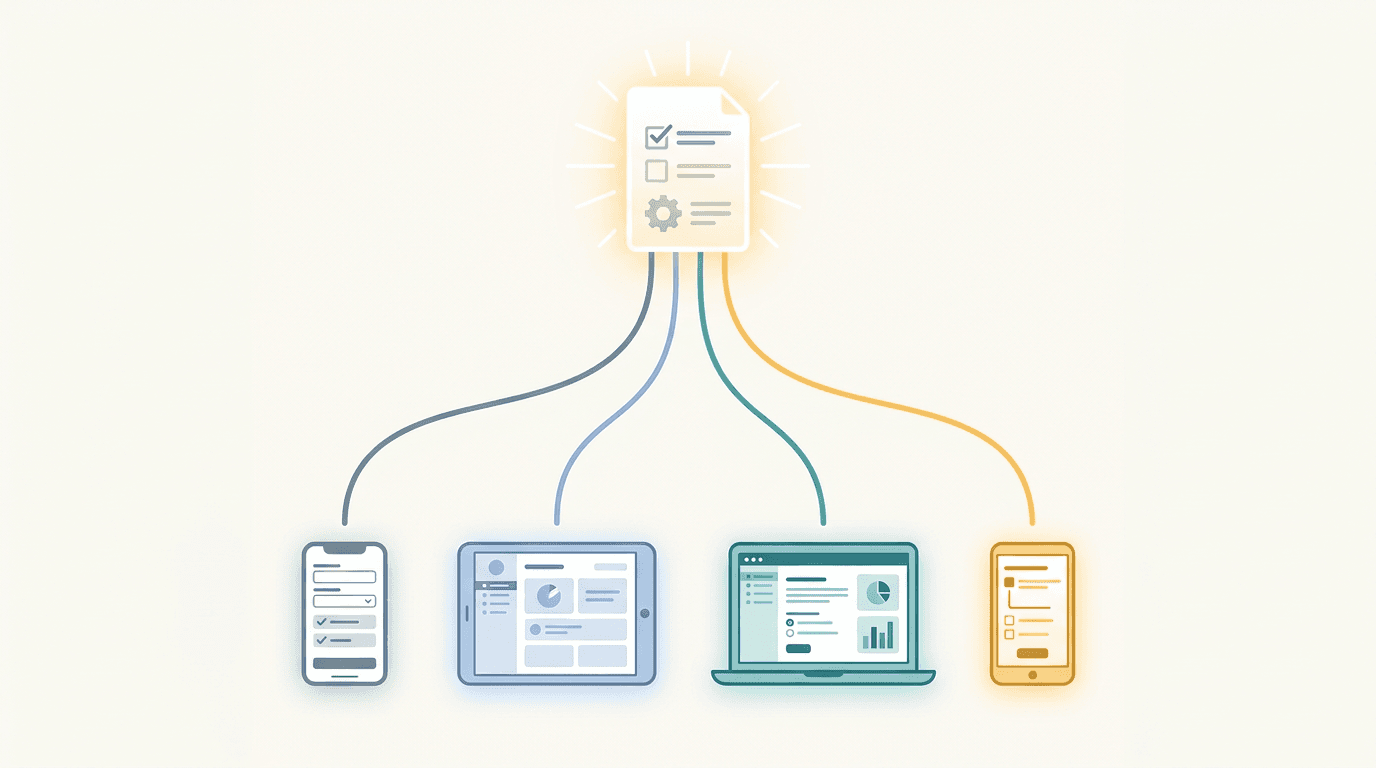
Generate platform-specific output from the validated AST. Decipher XML. Qualtrics QSF. ConfirmIt survey packages. Each output format is a different rendering of the same underlying survey.
The researcher interacts with the questionnaire. The machine handles the platform.
What this changes
Multi-platform deployment becomes a dropdown, not a project. The same questionnaire deploys to Decipher on Monday and Qualtrics on Tuesday. No re-programming, no reconciliation, no drift between versions.
Platform migration stops being a crisis. When a client switches from ConfirmIt to Qualtrics, you don't need to rewrite every active study. You re-deploy from the same source.
Researchers stop being platform specialists. Instead of hiring "Decipher programmers" and "Qualtrics programmers," you hire researchers who know research. The platform becomes an implementation detail.
Consistency improves. When one questionnaire generates all platform outputs, there's no risk of logic divergence between the Decipher version and the Qualtrics version. They're mathematically identical because they come from the same source.
The vendor lock-in problem
Platform lock-in doesn't just cost time — it distorts decisions.
Teams choose platforms based on which one they already know, not which one is best for the project. Clients stay on platforms they've outgrown because the migration cost is prohibitive. Junior researchers learn one platform deeply and can't transfer those skills elsewhere.
None of this serves the research. It serves the platform.
A platform-agnostic approach inverts the relationship. The platform is a deployment target, not a design constraint. If Qualtrics adds a feature that ConfirmIt doesn't have, you use Qualtrics for that project. If Decipher is better for complex routing, you deploy there. The questionnaire doesn't change — only the output format does.
This is where the industry is heading
Forsta's 2026 product announcements emphasize AI agents that work across the research lifecycle. Greenbook's 2026 predictions highlight "specialized research AI platforms" as a key success factor. The direction is clear: the value is in the intelligence layer above the platform, not in the platform itself.
Survey programming is the most obvious application of this principle. The questionnaire is the specification. The platform is the runtime. The translation between them should be automatic, reliable, and instant.
Questra programs your questionnaire once and deploys to Decipher, ConfirmIt, Qualtrics, and Alchemer — same logic, same validation, different platform. Try it.